

SURVEY RESULTS
U.S. tariffs expected to affect PCM sales
U.S. President Donald Trump’s “America First” trade policy led to a series of tariffs that have sent shock waves throughout the global economy, which Bloomberg reports could cost up to $1 trillion. The Phase Change Matters Newsletter conducted its first survey to determine whether readers think U.S. tariffs — and countermeasures taken by other nations — could affect the development and sales of phase change materials (PCM). The survey findings indicate that the major shifts in global free trade are expected to affect PCM markets, most notably supply chains and sales, with the United States and China feeling the greatest impacts.
 Of the 6% of newsletter readers who participated in the survey, the majority were PCM manufacturers, with 40% based in the European Union, 28% in the United States, 16% in India, and 4% each in China, South Korea, and the United Kingdom. About a third of respondents (32%) said they expect that U.S. tariffs and countermeasures will affect their own PCM research and development (R&D). One respondent said that increased costs would impact their pace of development, while others predicted that the United States will become increasingly insular and EU countries will shift to collaborating with China and India instead of the United States.
The most seismic changes may be found in the PCM markets. More than half of survey respondents (56%) said they expect tariffs and countermeasures to influence sales of their PCM products. Some outlined ways that sales could be affected, most notably higher costs leading to higher prices and lower demand, supply and inventory constraints and frustrations, and a decline in sales in the U.S. leading to shifting sales volume by region. One participant anticipated that there may be more opportunities for sales of EU products in the EU.
More than a quarter of those who participated in the survey (28%) said they expect U.S. tariffs and countermeasures will affect their PCM manufacturing operations. One participant said that their company will “shift business away from U.S. facilities unless supplying the U.S. market.”
The survey also asked participants to look beyond their own operations and weigh in on PCM development and sales globally. The majority of those surveyed said they expect U.S. tariffs could affect PCM research and development overall by shifting the focus to other regions (52%), as well as slowing down innovation and increasing costs (both 24%). (Please note that participants were able to select more than one response to many questions.) One respondent wrote that U.S. tariffs could lead to development of alternative thermal energy storage systems and another said they could lead to an increase in cooperation with non-U.S. partners. It should be noted that 40% of those surveyed said they do not think the tariffs will have any impact on R&D.
Countermeasures to U.S. tariffs could be similarly detrimental to R&D. Countermeasures could affect R&D by shifting focus to other regions (44%), slowing down innovation (40%) and increasing costs (36%), according to respondents. Less than a third (28%) said that countermeasures would have no impact on R&D.
PCM supply chains are also vulnerable to tariffs, according to survey participants. Nearly two-thirds said they expect increases in prices for raw materials (63%) and 58% expected exploration of alternative suppliers, with one respondent explaining that they would search for manufacturing locations outside of the United States. In addition, 46% said they expect disruptions in supply chains. One respondent called for parity, writing that it would be “better for U.S. that tariffs are even and reciprocal with other nations.”
Countermeasures to U.S. tariffs, such as retaliatory tariffs, could be even more disruptive. Whereas, 13% of respondents said tariffs will not have any impact on supply chains, only 8% said countermeasures will not have any impact. A majority of respondents said countermeasures could lead to exploration of alternative suppliers (68%) and price increases for raw materials (60%) and 44% said countermeasures could lead to supply chain disruptions.
However, survey participants indicated that PCM markets could be hit hardest by tariffs and their fallout. Three out of four of survey participants (76%) said that tariffs could affect PCM markets by promoting innovation outside of the United States and 71% said the same of countermeasures. More concerning were those who said tariffs — and resulting countermeasures — could lead to a decrease in market demand (24% and 38%, respectively). In addition, 32% said tariffs could lead to a shift toward different products and 38% said countermeasures could have the same effect.
Respondents clearly said that China (52%) and the United States (48%) will experience the most significant changes due to enactment of the new U.S. tariffs and countermeasures. The European Union came in third with 40% and the United Kingdom and India tied for fourth with both receiving 24%.
It’s clear that Phase Change Matters Newsletter readers believe that the trade wars will affect PCM development and sales. We will continue to monitor and report when warranted.
CASE STUDY
Some like it hot, but not vehicles
What is the problem?
Heat! Heat is a problem that plagues the automotive industry in many guises. For example, batteries in electric vehicles have a limited temperature window for optimal performance and lifetime and there is also a risk of thermal runaway when they are overloaded. In addition, heating or cooling the vehicle or its components consumes valuable energy that is needed to drive.
How can PCM technology solve it?
PCM can uphold ideal temperatures for a multitude of applications, including maintaining ideal conditions for power electronics and electric batteries, as well as providing heating in winter and cooling in summer without draining the battery charge.
Lutz Klinkner, managing director at Rubitherm (Berlin, Germany) gave a “Some Like It Hot” presentation on PCM at the WeAutomotive Group Battery Thermal Management Summit. In attendance were automotive original equipment manufacturers (OEMs) and large Tier 1 suppliers. Klinkner said he collaborated with Axiotherm (Eisenberg, Germany), Fraunhofer ISE (Freiberg, Germany), and PLUSS Advanced Technologies (Gurugram, India) to supplement Rubitherm’s examples “to showcase the widest possible spectrum of uses and impress the usefulness, series-readiness and versatility of high-quality PCM for automotive applications.” You may find Klinkner’s presentation here.
Case study is a new feature of the Phase Change Matters newsletter, showcasing how phase change materials are being used to solve problems in many sectors, including energy, transportation, construction, cold-chain logistics and textiles.
IN BRIEF
• Incooling (Eindhoven, the Netherlands) has announced that it is closing “operations in its current form,” which includes cutting staff. The company, which was founded seven years ago, created a thermal management solution based on phase-change cooling for data centers. “Going forward, we will focus on integrations into the offerings of major global providers. This approach allows us to scale our impact faster and more broadly, aligning our tech with those positioned to drive market change,” the company said in its LinkedIn post.
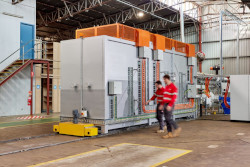 • 1414 Degrees (Adelaide, Australia) says its SiBox thermal energy storage system is the clean energy solution for heavy industry, delivering reliable, decarbonised heat up to 900°C. “SiBox’s core advantage lies in silicon’s thermal properties,” CTO Mahesh Venkataraman told create. “Silicon’s latent heat capacity, the energy absorbed or released during phase change, exceeds 1800 kJ/kg. This is three to four times higher than other materials, including metals or sand.” He further explained the advantages for industry. “We can provide heat anywhere from 200-900°C,” Venkataraman said. “SiBox covers a wide temperature range, which is a key advantage. We are among the few technologies at a high technology readiness level, ready for commercial demonstration.”
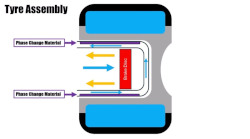 • McLaren (Jacksonville, Florida) enjoyed a victory lap after the Fédération Internationale de l’Automobile (FIA) declared its rear brake design legal. Red Bull had presented thermal images as evidence that McLaren used water in its tire cooling mechanisms, which would violate Formula 1 rules. However, it is highly speculated that McLaren uses PCM to prevent its wheels from degrading under the intense racing conditions. Scott Mansell of Driver 61 explained that brakes can generate temperatures exceeding 1,000°C that affect the wheel assembly and the tire. Mansell wrote that Martin Butcher, a former McLaren engineer, said the rubber tracks and tire maker “appears to be lining the inner surface of their wheel drums with phase change materials specifically selected to melt at the exact temperature of the optimal tire window.” Other F1 teams are taking notice and it’s likely that PCM technology will be used more widely in the racing world.
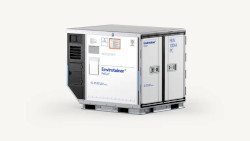 • Envirotainer (Stockholm, Sweden) launched Releye RKN, the smallest (single pallet) in its pharmaceutical air freight line. Releye RKN provides temperature control for more than five days (130+ hours) and integrated live monitoring. “Our new RelEye RKN enhances the safety of transporting lifesaving pharmaceuticals worldwide,” said CEO David Simonsson. “With six airlines already approving it for use, we are collaborating with pharmaceutical companies and logistics providers to support their qualification process, helping them integrate it seamlessly into their cold chain operations.”
 • PLUSS Advanced Technologies (Gurugram, India) announced it is partnering with Ecodome Logistics (Gurgaon, India) to provide PCM-based thermal boxes for Ecodome’s Internet-of-Things-enabled rental fleet. The collaboration is expected to reduce reliance on single-use Styrofoam and eliminate spoilage of medicines and biologicals. Sensors will relay real-time temperature and location information and a pay-per-use model makes reliable cold-chain transport more affordable. The new fleet will be introduced first in Hyderabad, Mumbai, Ahmedabad, Pune and the national capital region. The companies said they expect that the partnership “will accelerate adoption of PCM technology, strengthen vaccine security, and help India meet its climate commitments in healthcare logistics,” BioSpectrum reported. Pictured are Samit Jain, managing director of PLUSS Advanced Technologies, left, and Nihar Parida, co-founder of Ecodome Logistics.
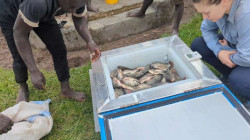 • Aston University (Birmingham, England) and RAD Global (Rukungiri, Uganda) collaborated to develop RADiCool containers, which use phase change material (PCM) and integrated internet of things (IoT) technology to help small farmers in East Africa keep food fresh. Tim Messeder, founder of UK agricultural development company RAD Global, said he noticed that 42% of fishers experienced spoilage during transport from remote locations. That’s what led him to reach out to Aston University to develop RADiCool, which provides cold storage for more than 24 hours in a box that can fit on motorbikes. Next steps include partnering with manufacturers, expanding field trials, and deploying a pay-per-use business model. “We’re proud to contribute scientific expertise that translates directly into practical, community-driven solutions,” said Dr. Ahmed Rezk, senior lecturer in mechanical, biomedical and design engineering at Aston University.
• PURE EV (Hyderabad, India) announced a strategic partnership with Charge Power Inc. (Toronto, Canada) to introduce PURE’s energy storage products to the U.S. and Canadian markets. Nishanth Dongari, founder and managing director of PURE, told Energetica India, “We are pleased to partner with Charge Power, whose team brings experience in delivering over 4GWh projects across North American along with deep EPC [engineering, procurement, and construction], marketing and sales expertise.”
• The 2025 IChemE Young Engineers Awards for Innovation and Sustainability (YEAIS) awarded students from Imperial College London with the overall undergraduate award for their EcoMed project, which was designed to make vaccines more accessible in remote parts of Africa. EcoMed’s solar-powered, thermoelectric refrigerator with a paraffin phase change material also won the food, health and wellbeing award, sponsored by Elsevier (Amsterdam, Netherlands). The Young Engineers Awards honor young professionals ages 18 to 30 who are helping to engineer a sustainable world.
• Melchior Krijgsman, co-founder of Entropic (Amsterdam, Netherlands), announced on LinkedIn that he has compiled a list of EU and North American companies that work on industrial-scale thermal energy storage (TES) technologies (including sensible, latent, and thermochemical) that help factories store and reuse heat, cut CO₂ emissions, and reduce energy costs. Those who want the list or who want to contribute to it are asked to send him a connection request and leave a comment “TES.” He said he intends to make the list public once it is complete.
• Eden Energy Equipment (Guelph, Ontario) has entered an exclusive distribution partnership for Sunamp’s (Macmerry, UK) Thermino batteries in the Ontario market, with the possibility of expansion to other regions in Canada.
• Tan90 Thermal Solutions (Chennai, India) raised more than $2.3 million in a Series A funding round. The startup employs proprietary PCM for sustainable thermal energy management in logistics, healthcare, food, agriculture, and manufacturing. “With this funding, we are accelerating our efforts to expand into new industries and markets, and build future-ready cooling solutions,” said co-founder Soumalya Mukherjee.
• Mayer Holdings (Hong Kong) announced that it has established multiple strategic partnerships with several universities (including Beijing University of Chemical Technology, Guangzhou Institute of Energy, Beijing University of Technology, and Shenzhen Technology University) to jointly develop PCM-related technologies.
PATENTS
Tank water heaters with phase change material
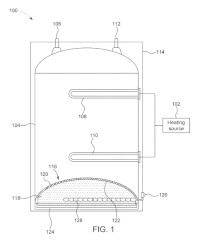 U.S. patent application 20250164149 (applicant Rheem Manufacturing Co., Atlanta, Georgia):
“A water heater including a storage tank and an energy source is disclosed. The storage tank may be configured to store water. The storage tank comprises a top portion and a bottom portion. The bottom portion includes an enclosure configured to store a phase changing material (PCM). The energy source may be configured to heat the PCM to a predefined temperature via a heating source disposed in the enclosure. The PCM may be configured to transfer heat to the water stored in the storage tank when a temperature of water stored in the storage tank drops below the predefined temperature.”
Insulation system utilizing phase change material
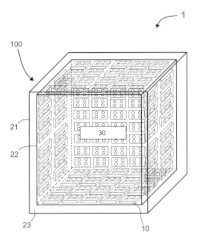 U.S. patent application 20250172333 (applicant BMIL Technologies, LLC, Morehead City, North Carolina):
“An insulation system for a refrigerated room or container. The insulation system includes a plurality of panels each panel having an outer side and an inner side surrounding an inner volume. There are PCM tanks disposed within the panels on the inner side, and the PCM tanks are surrounded by a thermally insulating rigid foam substrate and filled with phase change materials. The rigid foam contacts both the inner and outer side of the panels and is a structural member configured to support the PCM tanks to contact the inner side of the insulated panels.”
Thermal energy storage system with a heat pump for improved efficiency
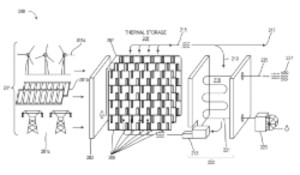 U.S. patent application /20250146428 (applicant Rondo Energy Inc., Alameda, California):
“An energy storage system converts variable renewable electricity (VRE) to continuous heat. Intermittent electrical energy heats a solid medium. Heat from the solid medium is delivered continuously on demand. An array of bricks incorporating internal radiation cavities is directly heated by thermal radiation. The cavities facilitate rapid, uniform heating via reradiation. Heat delivery via flowing gas establishes a thermocline which maintains high outlet temperature throughout discharge. Gas flows through structured pathways within the array, delivering heat which may be used for processes including calcination, hydrogen elecсtrolysis, steam generation, and thermal power generation and cogeneration. Low temperature waste heat from energy production can be recovered and used to improve overall system efficiency.”
More U.S. patent applications:
Polyether amine-based flexible phase change materials with high enthalpy value, preparation method and application thereof (Dalian University of Technology, Dalian, China.) | Passive cooling structural encapsulation system for battery cells (GM Global Technology Operations, LLC, Detroit, Michigan.) | Thermal energy conserving air handler (Martino Contractors, Ltd., Concord, California.) | Foam blend incorporating phase change material and method for making foamed shoe body using the same (Feng Tay Enterprises Co., Yunlin County, Taiwan.) | Thermal energy storage (Vital Energi Solutions Ltd., Blackburn Lancashire, England.) | Thermally stable nano-encapsulated phase-change material, methods for preparing the same, and its applications (Nano and Advanced Materials Institute Ltd., Hong Kong.) | Systems, devices, and methods for preserving an organ for transplantation (Traferox Technologies Inc., Toronto, Canada.)
RESEARCH ROUNDUP
From Buildings:
• Life Cycle Assessment of a PCM-Filled Compact Storage Module for Building Applications
From Materials Advances:
From Energy and Buildings:
From Energy:
• Triple-glazed windows with phase change materials and aerogel: Thermal performance across diverse climate zones
• Performance analysis of an HVAC system retrofitted with nano-enhanced phase change material-based heat exchanger
From Case Studies in Thermal Engineering:
• Solidification characteristics of biomass-activated aloe vera PCM in a spherical enclosure for efficient cool thermal energy storage
• Thermal Management Study of Cylindrical Battery Using Novel Thermally Conductive Anisotropic Flexible Phase Change Material
• Enhanced fusion dynamics of graphene-infused phase change materials in a concentric tube system for optimized solar thermal energy storage
From Applied Thermal Engineering:
From Materials Chemistry and Physics:
• Graphene/moss biomass/lauryl alcohol composites for thermal energy storage
From Energy Conversion and Management: X:
• Optimisation of metastable supercooled liquid phase change material for long-term heat energy accumulation
• In-situ gold/gold nanorods/graphene nanoplatelets-enhanced phase change materials with superior solar thermal conversion and deicing capability
From Thermal Science and Engineering Progress:
From Renewable Energy:
From Journal of Energy Storage:
• A novel flexible dual-mode phase change material for year-round energy saving
• High cycling stability, hydrogen-bonds strengthening Mg(NO3)2·6H2O-propionamide composite phase change materials as energy storage material for solar thermal system
• Highly stretchable, strain-resilient conductive phase change fibers coupled with Joule/solar heating ability for all-weather personal thermoregulation
• Experimental study on the thermal performance of a large 100 MJ cascaded packed-bed thermal energy storage system with macro-encapsulation of phase change materials
From Journal of Building Engineering:
• Nature inspired vascular self-thermal responsive cementitious composites with phase change materials
• Thermal performance evaluation of innovative phase change material-based cubes for sustainable building design: numerical modeling and energy savings assessment
From Materials Science and Engineering: B:
From International Journal of Heat and Mass Transfer:
From Solar Energy:
From Materialia:
NETWORKING
Connect with PCM experts and industry leaders on LinkedIn
 More than 1,800 people have joined a LinkedIn group devoted to the discussion of phase change material and thermal energy storage. You are invited to join the Phase Change Matters group and connect with PCM and TES experts from around the world.
This month we welcome Francesco Valentini, postdoctoral researcher at Università di Trento, Trento, Italy; Zolboo Myagmarsukh, Ph.D. candidate at Hanyang University, Seoul, South Korea; and Nurten Sahan, Marie Curie postdoctoral fellow at Northumbria University, Newcastle upon Tyne, England.
NEWS TIPS
Does your company, agency or university have a job opening, new research, new product or other news you’d like to share? I would love to hear from you. Please contact newsletter editor Amy Phillips at phasechangematters@gmail.com.
A WORD FROM OUR SPONSOR
 This newsletter is made possible through the generous support of the RAL Quality Association PCM and the members listed below. To learn more about the association, including membership benefits, please contact Stefan Thomann, executive director, at pcm@kellencompany.com.
Axiotherm GmbH | B Medical Systems | Croda International Plc. | ISU Chemical Co. Ltd. | RuhrTech | Microtek Laboratories | PCM Technology | PLUSS Advanced Technologies | PureTemp LLC | Rubitherm Technologies GmbH | Sasol Germany GmbH | S.Lab Asia Inc. | Sunamp Ltd. | va-Q-tec AG